Bridging the dealer engagement gap
Why better dealer support is becoming the key to stronger dealer network performance
Strong, supported dealer relationships are central to the success of many marketing departments’ performance. Dealers are the gatekeepers of your sales success, and your brand champions when the partnership is well supported.
The challenge is that every dealership is different. They each have their own customers, priorities, sales targets and ways of working. Many represent several competing brands, all vying for the same showroom space, website visibility and local marketing activity.
Achieving a consistent level of motivation, participation and execution across this network of independent businesses is the core of a winning strategy. If some of your dealers aren’t delivering enough for you, could there be a disconnect in your support to them?
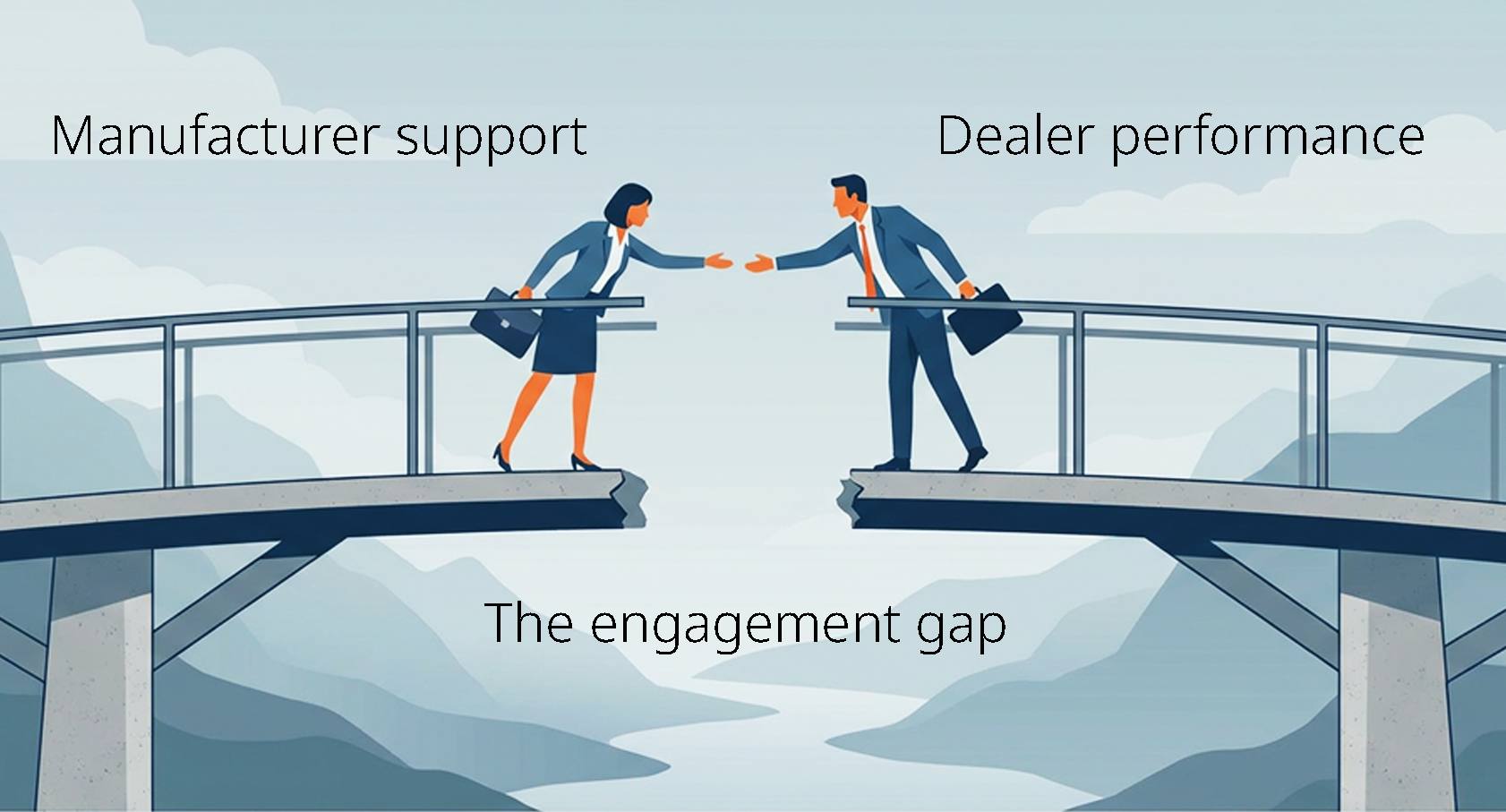
This is the
dealer engagement gap. The answer isn’t always more marketing, it’s often closer dealer support.
The commercial challenge
A dealer network provides local expertise, trusted customer relationships and a national presence that would be difficult to build centrally. But they also create a marketing challenge.
Your brand is represented by a network of independent businesses, each with different priorities, different resources and different levels of marketing expertise. So unlike businesses with a direct sales model, you don't control the customer interaction. You build your brand, the dealers build local relationships.
Generally speaking, manufacturers want the same thing: Engaged dealers, consistent branding, effective local marketing and strong sales performance outcomes. The strongest dealer networks succeed because they combine these strengths.
Yet many discover that creating high-quality marketing support is just the beginning. The real challenge is making sure it lands well with your dealers and that they deploy it effectively. This is the opportunity to bridge the dealer engagement gap.
Understanding the Dealer Engagement Gap
The marketing department create exciting campaigns. You prepare smart, creative assets. You distribute materials. And right here is where the engagement gap starts to show itself.
Your dealers don’t operate like an extension of your office. They’re thinking about their monthly sales target and how their margins are holding up and everything else they have to deal with on a daily basis.
What looks like available support from a manufacturer doesn’t always translate into easy to use at dealer level.
And that difference matters.
Bridging the dealer engagement gap
We have seen what the better-performing dealer networks tend to get right.
It’s rarely about having more resources or more sophisticated marketing concepts. It usually comes down to something simpler: You’ve made it easier for dealers to engage and work with your brand.
In practice, it looks like this
- Dealers have direct access to what they need quickl
- There’s no confusion about what is current or approve
- Materials are ready to use for different formats and channel
- Localisation is simple, quick and automate
- Letting dealers chose from different creative styles, brand imagery, or maybe a headline adds some fun, involvement and ownership to the work
- A system that fits into how dealers already work
Underpinning all of that is a simple reality:
If it’s easy to use, it gets used. If it isn’t, it doesn’t
And, of course, if you are marketing into multi-brand dealerships, the imperative is that your approach is better, and more visible, than the rest!
Dealer support as a commercial capability
Forward-thinking manufacturers are beginning to see dealer support differently. Rather than viewing it simply as a marketing function, they're recognising it as a commercial capability that influences the performance of the entire dealer network.
Well-designed dealer support helps dealers market more confidently, improves campaign adoption, strengthens brand consistency and reduces the administrative burden on central marketing teams.

A managed dealer support system also provides something many manufacturers have historically lacked: visibility.
Platform-based marketing means you measure the activity of each dealer in your network with simple, real-time analysis of who’s doing what and when.
Spot the big users and reward them with extra content and personal attention. See who is falling behind so that you offer more support and identify obstacles that you might have missed in the way they work with your marketing or some special requirements of their business model.
These systems can also show which marketing assets are most and least popular, steering your future campaigns with real data. This informs decisions so that you can do more of what works and avoid wasted time of collateral that isn’t so popular.
Arriving at the right platform
The Resourcebase marketing platform is built around a simple principle:
make dealer support easier
- It provides manufacturers with a central platform for organising campaigns, marketing assets, sales resources and brand materials, while making them simple for dealers to access, personalise and use
- Approved templates can be localised without compromising brand standards
- Campaigns can be rolled out consistently across the network
- Dealers can quickly find the resources they need without relying on manual requests or disconnected systems
- At the same time, marketing teams retain control over brand integrity while gaining valuable insight into how resources are being used across the network
The result is a dealer support programme that is easier to manage, easier for dealers to engage with and easier to measure
The way forward
Dealer networks aren’t becoming simpler. There are more channels, more content, more expectations, and more pressure on performance than ever before.
So the challenge of dealer support is going to become increasingly important to get right – and get it more right than your competitors.
Because when dealer support is easy to use, engagement improves. And when engagement improves, performance follows. That’s the real opportunity in bridging the dealer engagement gap.